Evaluating God Bless Rhinestone Templates for Creative Projects
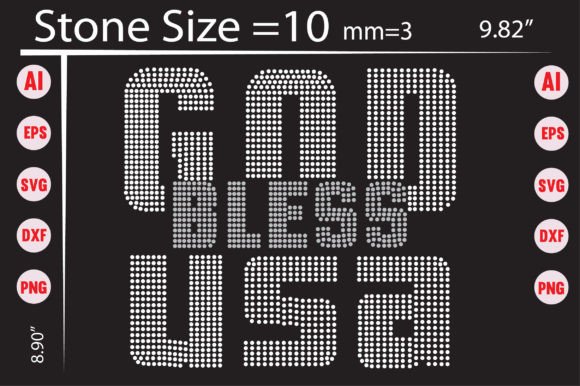
When exploring the world of digital crafting, specifically within the niche of apparel and home décor customization, the decision between various design assets often comes down to file compatibility, production workflow, and the specific aesthetic requirements of the project. The God Bless Rhinestone Templates Design represents a specific category of digital resource intended for creators who work with heat transfer vinyl (HTV), sublimation, or rhinestone application. Unlike standard graphic design assets that are intended purely for print-on-demand photography or digital display, these templates are engineered with material application in mind.
Understanding the File Ecosystem
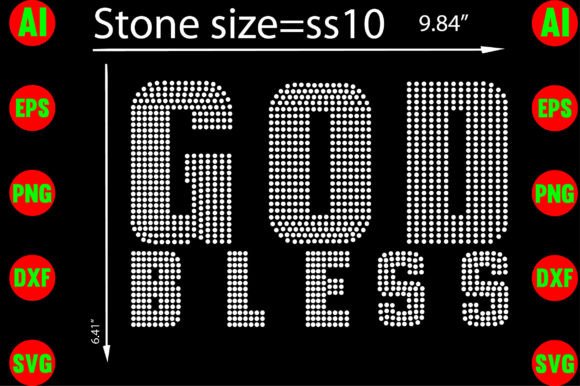
The primary distinction of the God Bless Rhinestone Templates Design lies in its comprehensive file delivery. When evaluating this type of resource, the inclusion of AI, EPS, SVG, DXF, Transparent PNG, and JPEG formats is not merely a convenience but a technical necessity for diverse manufacturing processes. For the experienced crafter or small business owner, the presence of vector files (AI, EPS, SVG) is critical because it allows for infinite scalability without loss of resolution. This is particularly important when adapting a design for a small chest logo versus a large back print.
However, the inclusion of DXF files is a specific consideration for users of certain cutting machines. While modern software often favors SVGs, older machines or specific legacy software may require the DXF format to translate the vector paths into cut lines for vinyl or rhinestone templates. Therefore, when comparing this template set to others that might only offer PNG or JPG, the God Bless Rhinestone Templates Design offers a higher degree of versatility across different hardware ecosystems.
Resolution and Output Quality
A key specification to evaluate is the 300dpi resolution across the board. In the realm of sublimation and direct-to-garment (DTG) printing, 300dpi is the professional standard for ensuring crisp edges and color accuracy. A common tradeoff in cheaper or free templates is the provision of low-resolution web graphics (72dpi) that pixelate upon printing. By adhering to 300dpi, this design ensures that the raster files (PNG and JPEG) are print-ready immediately upon download, reducing the need for time-consuming upscaling or manual tracing by the end user.
Comparing Use Cases: Rhinestones vs. Standard Vinyl
It is important to distinguish the intended application of the God Bless Rhinestone Templates Design. While the file formats provided are compatible with standard vinyl cutting, the design itself is likely optimized for the density and spacing required in rhinestone application. Rhinestone templates require specific considerations regarding the "bridge" areas between stones and the overall flow of the design to ensure physical stones adhere correctly.
Compared to a standard vector illustration, a rhinestone template often features distinct clusters or outlines. If a user is looking for a design primarily for screen printing or single-color vinyl, they might find a standard vector illustration more adaptable. Conversely, if the goal is to create a textured, sparkling finish on a t-shirt or cushion, this specific template design saves significant manual labor. Manually converting a standard image into a rhinestone pattern requires specialized software and expertise; purchasing a pre-made template like this one acts as a shortcut to professional results.
Practical Applications and Material Considerations
The versatility of the God Bless Rhinestone Templates Design extends beyond apparel. The description highlights its utility for mugs, cushions, and general projects. When evaluating this for mugs, one must consider the curvature of the surface. A flat vector design may need to be warped slightly to adhere to a cylindrical object without bubbling. The editable nature of the provided files (AI and EPS) allows users to manipulate the design to account for these physical constraints, a feature that static, non-editable files do not offer.
Strengths and Tradeoffs
The primary strength of this offering is the instant download capability and the inclusion of editable source files. For a business owner fulfilling orders on a tight deadline, immediate access is a critical operational requirement. The tradeoff, however, lies in the "template" nature of the product. Because it is a widely available digital asset, there is a risk of market saturation—other sellers may use the exact same design.
For those seeking absolute uniqueness, a template serves best as a starting point. The editable files allow for color changes, text additions, or slight modifications to ensure the final product feels distinct. If a user requires a completely bespoke design for a trademarked brand or a specific client, commissioning a custom graphic designer would be the superior, albeit more expensive and time-consuming, alternative.
Decision Factors for the Creator
When deciding if the God Bless Rhinestone Templates Design fits your needs, consider the following factors:
- Software Proficiency: Do you have access to software capable of opening and editing AI or EPS files (such as Adobe Illustrator or Affinity Designer)? If you are strictly using a drag-and-drop interface that only accepts PNGs, the vector capabilities may be underutilized.
- Production Method: Are you strictly doing sublimation, or are you working with actual rhinestones? If the latter, ensure the design's complexity matches your patience and budget for materials, as high-stone-count designs increase material costs.
- Commercial Intent: The description implies permission for commercial use (printing on items for sale), but it is always prudent to verify the specific licensing terms to ensure they cover the volume of production you anticipate.
Ultimately, this template serves as a robust resource for the mid-level to advanced crafter who values file diversity and print quality. It bridges the gap between amateur web graphics and professional production files, offering a practical solution for those looking to expand their product catalog with faith-based or inspirational themes. By understanding the technical specifications and comparing them against your specific production hardware and software, you can determine if this asset provides the necessary value for your workflow.