Asap Rocky Rhinestone Templates Design: A Creative Guide for Modern Projects
Understanding the Digital Asset Ecosystem
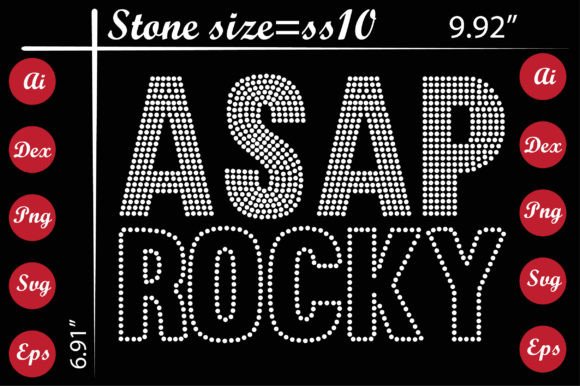
In the realm of digital crafting and print-on-demand, the quality of the source file determines the success of the final product. A professional Asap Rocky Rhinestone Templates Design package represents a specific category of digital asset engineered for precision and versatility. Unlike standard raster images, these templates are typically constructed with vector logic, allowing for infinite scalability without pixelation. The core value of such a design lies in its ability to translate a complex visual concept into a format that machines—such as vinyl cutters, direct-to-garment printers, and laser engravers—can interpret accurately.
The "Instant Download" nature of modern design marketplaces has revolutionized how creators access these assets. Instead of waiting for physical shipment or hiring a graphic designer for a custom illustration, users can acquire a high-resolution file immediately. However, the utility of the file depends heavily on the format provided. A comprehensive package usually includes a mix of vector and raster files to ensure compatibility across different software environments and hardware capabilities.
The Anatomy of a High-Fidelity Template
When analyzing a professional template package, specifically an Asap Rocky Rhinestone Templates Design, the technical specifications are paramount. The inclusion of Ai (Adobe Illustrator) and EPS formats at 300dpi indicates that the design is editable at the vector level. This is crucial for creators who need to adjust the layout, change colors to match specific vinyl inventory, or resize the image for a garment that differs from the standard placement.
Furthermore, the availability of SVG (Scalable Vector Graphics) and DXF (Drawing Exchange Format) files is essential for users operating cutting machines like Cricut or Silhouette. These formats contain the path data required for the machine blade to trace the design accurately. For print-based applications, the Transparent PNG and JPEG at 300ppi/dpi ensure that the image retains clarity when transferred onto fabric or rigid surfaces. The transparency of the PNG is particularly valuable as it removes the need for the creator to manually "knock out" the background, saving significant time in pre-production.
Workflow Integration and Production Methods
The true test of an Asap Rocky Rhinestone Templates Design is its integration into a production workflow. The process varies significantly depending on the intended medium. For sublimation printing, the design is printed onto special paper using sublimation ink and then heat-pressed onto polyester fabrics. The 300dpi resolution ensures that the ink saturation is consistent, preventing the "faded" look often associated with low-resolution source files.
For traditional rhinestone application, the workflow is more labor-intensive. The template is used to create a stencil, often using a magnetic board or sticky flock material. The creator then manually fills the holes with rhinestones before transferring them to the garment using heat. While the digital file facilitates the creation of the stencil, the physical application requires a steady hand and an understanding of heat-press temperatures to ensure the adhesive on the back of the stones bonds permanently with the fabric without scorching the material.
Material Considerations and Durability
The choice of substrate—what the design is applied to—plays a critical role in the longevity of the project. Cotton and cotton-poly blends are generally preferred for screen printing and heat transfer vinyl (HTV) applications because they withstand high heat well. However, when working with an Asap Rocky Rhinestone Templates Design intended for mugs or cushions, the material science changes.
Ceramic mugs typically require a polyester-coated surface for sublimation to bond correctly. Cushions, depending on the fabric (velvet, linen, or polyester), react differently to heat and pressure. A professional template package acknowledges these variations by providing the design in formats that can be easily manipulated to suit the specific curvature of a mug or the texture of a throw pillow.
Target Audience and Practical Applications
The versatility of the Asap Rocky Rhinestone Templates Design extends its appeal across various demographics. Small business owners in the streetwear sector utilize these designs to create limited-edition merchandise that capitalizes on pop culture trends. The editable nature of the files allows them to create "remixes" of the design, ensuring their products stand out in a crowded market while maintaining the aesthetic appeal of the original template.
Educators and workshop facilitators also find value in these assets. In a design class or a makerspace setting, the template serves as a real-world example of file management, color separation, and print preparation. Students can learn the technical differences between vector and raster workflows by experimenting with the same design across different software platforms.
Customization and Branding
One of the most significant advantages of an editable file is the potential for branding. A business owner might use the Asap Rocky Rhinestone Templates Design as a base but alter the color palette to match their brand identity or add text elements to commemorate a specific event. The ability to deconstruct the file—separating layers, isolating elements, and recoloring paths—transforms a static template into a dynamic creative tool.
For hobbyists and DIY enthusiasts, the appeal is often immediate gratification combined with creative control. The "Instant Download" feature means a crafter can decide to make a custom t-shirt for an event and have the design ready to cut or print within minutes. The inclusion of high-resolution formats ensures that the final product looks professional, regardless of whether it is a single item or a batch production run.
Technical Precision in Design Execution
The difference between an amateur project and a professional product often lies in the technical precision of the design execution. An Asap Rocky Rhinestone Templates Design optimized for 300dpi output ensures that fine details are not lost during the rasterization process. This is particularly important for designs that feature intricate line work or small text elements, which can become muddy or illegible at lower resolutions.
The vector formats (Ai, EPS, SVG) are resolution-independent, meaning they can be scaled from the size of a postage stamp to a billboard without losing quality. This scalability is essential for creators who may want to use the same design for a small chest logo on a t-shirt and a large back print. The mathematical precision of vector paths ensures that curves remain smooth and edges remain crisp, regardless of the final output size.
File Management and Organization
Receiving a ZIP folder with multiple file types requires a basic understanding of file management. The user must identify which file type is appropriate for their specific software and hardware. For example, a user with Adobe Illustrator will prioritize the .ai or .eps files for editing, while a user with a Cricut machine will import the .svg or .dxf file into their design space software. The transparent PNG is the universal fallback for users who do not have vector editing software but need to place the image onto a background without a white box surrounding it.
Proper organization of these files prevents workflow bottlenecks. Best practices include creating a dedicated project folder, renaming files to reflect their specific use case (e.g., "Front_Print_SVG" or "Mug_Sublimation_PNG"), and backing up the original files before making any modifications. This ensures that the creator can always revert to the original state if a modification goes wrong.
Market Trends and Digital Design Evolution
The demand for culturally relevant digital assets continues to grow as the creator economy expands. Templates that bridge the gap between high art and street culture, such as the Asap Rocky Rhinestone Templates Design, occupy a unique niche. They provide a shortcut to high-quality aesthetics that would otherwise require significant artistic skill to produce from scratch.
As technology advances, the integration of these templates into automated workflows is becoming more seamless. Direct-to-garment (DTG) printers and laser cutters are becoming more accessible to home users, increasing the market for high-quality, ready-to-use design files. The future of this sector lies in the continued refinement of file compatibility and the provision of comprehensive instruction sets that help users navigate the technical aspects of production.
Ultimately, the value of a template is measured by its ability to empower the creator. Whether used for commercial gain, educational purposes, or personal expression, a well-constructed design file serves as a bridge between a creative idea and a tangible, high-quality product. The availability of comprehensive file formats ensures that this bridge is accessible to users of all skill levels and technical setups.